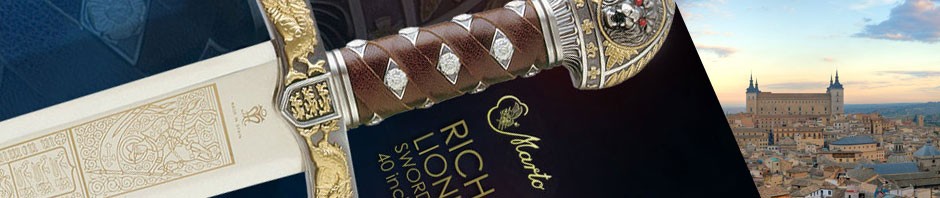
Top 10 legendary swords in history. List of famous swords worn by a legendary knights, heroes and kings. Excalibur sword, King Solomon sword, William Wallace sword, Swords of El Cid, Masamune sword, Durendal sword, Zulfiqar Sword, Kusanagi sword, Hrunting.

Excalibur-Sword of King Arthur
King Arthur’s sword, symbol of divine kingship, is as much a character in the legend as any human or supernatural being. Excalibur is a symbol of the responsibility of power.
There are two explanations of the way in which Arthur acquires Excalibur. Contemporary story-tellers are fond of “the sword in the stone” narrative in which young Arthur pulls the magical sword from a rock and anvil bearing this inscription: “Whoso pulleth out this sword of this stone and anvil is likewise King of all England.”
A second version describes Arthur and Merlin riding to a lake. Here they “see an arm clothed in white samite, rising from the water and holding a sword. Presently a damsel rides rapidly toward them, and at Merlin’s bidding dismounts and walks with dry feet over the water. She takes the sword, the arm vanishes,and the damsel brings the coveted weapon back to Arthur.”
Excalibur’s scabbard was said to have powers of its own. Injuries from losses of blood, for example, would not kill the bearer. In some tellings, wounds received by one wearing the scabbard did not bleed at all. The scabbard is stolen by Morgan le Fay and thrown into a lake, Arthur was mortally wounded then.
Durendal-Sword of Roland
Roland was a knight paladin of the Charlemagne. He died braverly in fight against Moors.
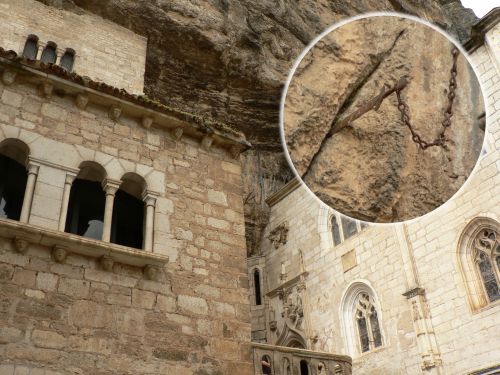
Durendal or Durandal, the sword of Roland, fabled to have once belonged to Hector (the best warrior of Troy), and which, like the horn, Roland won from the giant Jutmundus. It had in its hilt a thread from the cloak of the Virgin Mary, a tooth of St. Peter, a hair of St. Denys, and a drop of St. Basil’s blood. Legend has it that Roland, mortally wounded at Roncesvalles, strove to break Durandal on a rock to prevent it falling in the hands of the Saracens. The sword, however, was unbreakable so he hurled it into a poisoned stream, where it remains for ever.
For hundreds of years, a mysterious sword had been embedded in the cliffs above the Notre Dame chapel in Rocamadour, France. The monks say it is Durandal, sword of the paladin Roland. According to legend, Roland hurled the holy blade into the side of the cliff to keep it from being captured by his enemies. Since the 12th century, the chapel has been a destination for sacred pilgrimages. In 2011, the sword was removed by the local municipality and given to the Cluny Museum in Paris for an exhibit.
Joyeuse-Sword of Charlemagne
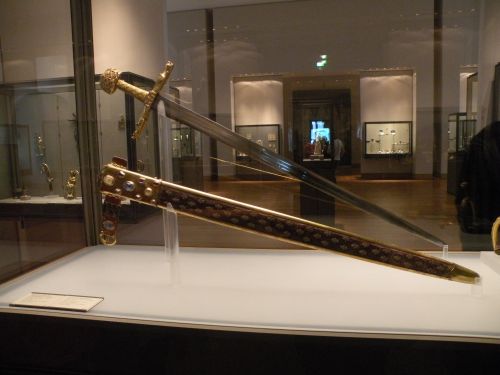
Joyeuse, legendary sword of Charlemagne, was said to change colors 30 times every day, and was so bright it outshone the sun.
One potential Joyeuse sword can be found in Louvre museum in Paris, France.
The sword has been part of French coronation ceremonies.
The other contender is the “saber of Charlemagne” housed in the Imperial Treasury in Vienna.
Tizona and Colada swords of El Cid
El Cid (Rodrigo Diaz de Vivar) was a Castilian military and political leader in medieval Spain. Born of the Spanish nobility and nicknamed El Cid Campeador, Rodrigo Díaz was educated in the royal court of the Kingdom of Castile and became an important general and administrator, fighting against the Moors in the early Reconquista. Later exiled by Afonso VI, El Cid left service in Castile and worked as a mercenary-general for other rulers, both Moor and Christian. Late in life, El Cid captured the Mediterranean coastal city of Valencia, ruling it until his death in 1099. Fletcher (2003) describes him as the “most famous Spaniard of all time”.
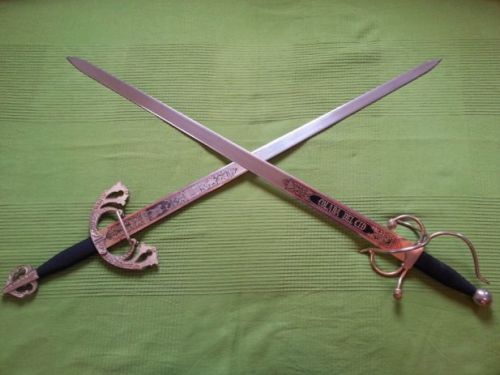
Tizona and Colada swords terrified unworthy enemies into a swoon at mere sight.
In a museum in Burgos, Spain, there is a controversial sword which the museum claims is none other than El Cid’s own blade.
The sword’s authenticity is disputable.
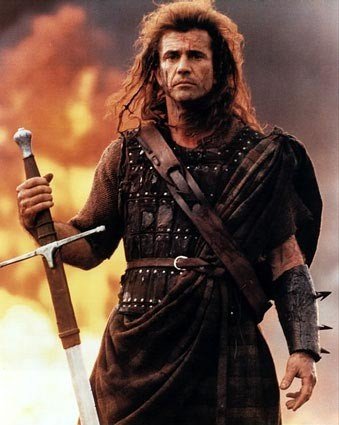
Sword of William Wallace
William Wallace a Scottish national hero who led a resistance to the English occupation of Scotland during the Wars of Scottish Independence (13th century). Sword of Wallace was a guhe two handed Scottish broadsword. It is said that the sword have been used by William Wallace at the Battle of Stirling in 1297 and the Battle of Falkirk (1298).
According to legend, Wallace’s sword scabbard, hilt and belt were said to have been made from the dried skin of Hugh Cressingham, one of the English commanders at the Battle of Stirling Bridge.
It has been alleged that after William Wallace’s execution in 1305, Sir John de Menteith, governor of Dumbarton Castle received the sword.
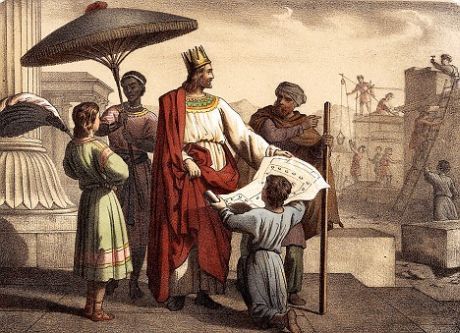
Sword of King Solomon
King Solomon (10th century BC) was one of the most famous Judaic kings. Solomon was son od David and he was famous by his wisdom and judgements.
Two young women who lived in the same house and who both had an infant son came to Solomon for a judgment. One of the women claimed that the other, after accidentally smothering her own son while sleeping, had exchanged the two children to make it appear that the living child was hers. The other woman denied this and so both women claimed to be the mother of the living son and said that the dead boy belonged to the other.
After some deliberation, King Solomon called for a sword to be brought before him. He declared that there was only one fair solution: the live son must be split in two, each woman receiving half of the child. Upon hearing this terrible verdict, the boy’s true mother cried out, “Oh Lord, give the baby to her, just don’t kill him!” The liar, in her bitter jealousy, exclaimed, “It shall be neither mine nor yours—divide it!”
The king declared the first mother as the true mother, as a true, loving mother would rather surrender her baby to another than hurt him, and gave her the baby. King Solomon’s judgment became known throughout all of Israel and was considered an example of profound wisdom.
The expressions “splitting the baby” or “cutting the baby in half” are sometimes used in the legal profession for a form of simple compromise.
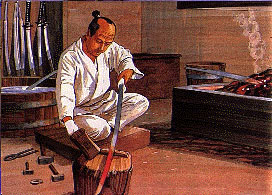
Honjo Masamune Sword
Masamune was the greatest swordsmith in Japanese history. His swords are known for their unparalleled beauty and quality.
One legend about Masamune relates to a competition he had with his rival, Sengo Muramasa. Both men crafted swords and suspended them over a stream to test their quality. Muramasa’s blade cut everything that touched it, notably fish and leaves; by contrast Masamune’s sword cut only the leaves and repelled the fish. Muramasa took this as a sign that his sword was better and began to gloat. However, a wandering monk had been watching them and explained that Masamune’s sword was superior as it did not cut unnecessarily. In cutting everything that touched it Muramasa’s sword showed its blood-thirsty and evil nature. As such this led to a tradition that a Muramasa blade must taste blood before being sheathed, even to the point of its owner having to harm himself to do so, in order to slake its evil thirst.
Another legend says that the sword was so well balanced that it is able to cut through light, rendering the user invisible.

Zulfiqar Sword of Ali
Zulfiqar is legendary sword of Islamic history. The Zulfigar sword was given by Muhammad to Ali.
Ali used the sword at the Battle of the Trench to cut a fierce Meccan opponent and his shield in two halves. The opponent was Amr ibn Abdawud, whose strength was often compared to that of a thousand men. No one had dared to fight him except Ali, who killed him with one powerful blow.
The sword was also used in the Battle of Karbala by Imam Hussain, and as a result it is seen as a symbol of honor and martyrdom. And it is now believed by the Shias to be in the possession of Imam Mehdi.
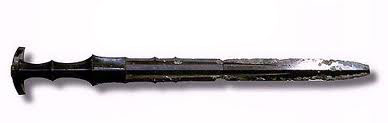
Kusanagi Sword
Kusanagi-no-Tsurugi is a legendary Japanese sword and one of three Imperial Regalia of Japan. It was originally called Ame-no-Murakumo-no-Tsurugi-“Sword of the Gathering Clouds of Heaven” but its name was later changed to the more popular Kusanagi-no-Tsurugi-“Grass Cutting Sword”.
Kusanagi sword was discovered from the body of a giant serpent. In the reign of the XII Emperor, the sword was gifted to Yamato Takeru, who was led into an open grassland as a trap by a warlord. The plan was to ignite the grass and burn Yamato to death. In desperation, Yamato started cutting the grass with his sword and discovered to his amazement that he could control the wind. Using this power, Yamato expanded the fire in the direction of his enemies, defeating them. It was after this incident that Yamato named the sword as “Grasscutter Sword”. Yamato was later killed in a battle by a monster when he ignored his wife’s advice to take the Grasscutter sword with him.
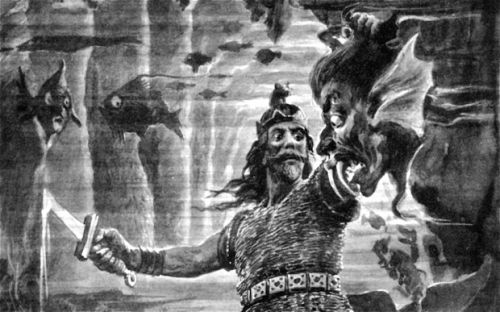
Hrunting-Sword of Beowulf
Hrunting was given to Beowulf by Unferth, a servant of the Danish lord Hroogar.
Hrunting sword possessed great power and was claimed to have never failed anyone who used it, when Beowulf descended to the bottom of the lake to fight Grendel’s mother, the sword proved ineffective. As the “fabulous powers of that heirloom failed,” Beowulf was forced to discard it.
Good list.
I was hoping to see Ulfberht on the list